Saturday, 30 May 2015

Rustic Wild Garlic Pesto

It's another beautiful day here in Perthshire, so the pup and I went for a walk around the Birks of Aberfeldy. We were greeted on the walk by the pungent aroma of Wild Garlic. Cue a new recipe - Wild Garlic Pesto.

As with many wild foods, there are some poisonous lookalikes - Lily of the Valley, for example. Wild garlic can be identified by its starburst-esque white flowers and the aroma of garlic. Please make sure you identify it correctly, before you eat it.

As I'm camping, I'm using my gran's system of measurement of "just enough so it looks right" - I never will know how she made pancakes. Also, I don't have a battery-operated food processor, so I used my peg mallet and a plastic bag to crush my nuts.

Wild Garlic Pesto and Chicken sandwiches

Ingredients:
A handful of Wild Garlic leaves
2 tablespoons of grated Parmesan
A squeeze of lemon juice
A handful of Cashew Nuts
Approx 50ml Toasted Sesame Oil
Salt
Pepper
Bread

Method:
Chop the garlic leaves
Crush the nuts
Mix together with parmesan
Add oil a little at a time and blend together
Add lemon juice
Season to taste

I wanted a chunky, spreadable pesto, but you could add more oil and use a food processor to get a finer paste.

I'm presuming you know how to cook chicken, so do that.

Eat chicken and pesto in a sandwich.

Yum! And until next time, Happy Foraging! X


Friday, 29 May 2015

Sweet Cicely Chicken

Last night I went to bed feeling sad that the weather was thwarting my weekend camping plans. Then I woke up this morning to a completely new forecast - it would appear that the sun is shining on me, after all. So I packed the tent and the pup and headed North.

I found a beautiful wee spot on the banks of the River Tay, just South of Pitlochry. The best bit about this spot? It is surrounded by Sweet Cicely!

Sweet Cicely does look very similar to a few other plants, and significantly similar to deadly Hemlock, so please ensure you know what you are picking before you eat it. Sweet Cicely smells like aniseed, so one way of identifying it is to rub the leaves between your fingers and then smell them. If it doesn't smell like aniseed, then it isn't Sweet Cicely.

Today I cooked with the leaves, but later in the season you can also eat the green seeds - they add a sweetness, so are often used as a sugar subsitute. The roots are also edible and can be prepared in dishes as a substitute for Fennel.

Campfire Sweet Cicely and Chicken

Ingredients:
Oil
2 chicken breasts - diced
150ml creme fraiche
1 red onion - finely chopped
Small handful of Sweet Cicely leaves
Salt
Pepper

Method:
Cook onion in oil until softened
Brown chicken with onions
Add Sweet Cicely and allow to wilt
Add creme fraiche and stir well to combine all ingredients
Cook until chicken is cooked through (about 5mins)
Season and serve

I have to say that this meal was absolutely delicious and will be added to my go-to recipes for camping. I'm off to enjoy the sun, now. Until next time - Happy Foraging! X

Thursday, 28 May 2015

St. George's Stroganoff

Today, as I parked my car at work, a few twinkles of white caught my eye, so I went to explore...

There, snuggled and huddled together in the undergrowth, were a family of St. George's mushrooms. The first mushrooms of my 2015 season and what an excellent start to the day!

St George's Mushrooms are so-named because they arrive around St George's Day (23rd April), although I've only ever seen them towards the end of May.

I am still wary about picking gilled mushrooms, because there are many poisonous wild varieties. Gilled mushrooms are the most similar to cultivated mushrooms and are very different (aesthetically) from Chanterelle (vein-like gills), Boletes (pored) and Hedgehogs (toothed).

I had hoped to get out camping this weekend, but the wind is picking up and thunderstorms are forecast. Instead, I got out my campstove and made Mushroom Stroganoff on my patio. At least it was outdoors!

I've enjoyed watching Spring growing around me, and am delighted to see Sweet Cicely appearing, now. I can sense a Sweet Cicely Chicken (perhaps even Chicken-of-the-Woods) concoction on the horizon. Until we meet again, Happy Foraging x

Friday, 15 May 2015

Gorse Blossom & Blackthorn Blossom Liqueurs

Today started out with the sun shining, so I grabbed the dog and headed up to the local country park for a little Spring foraging. I wasn't disappointed. As we turned a corner, a breeze brought with it the coconut-scent of Gorse. The smell set my mind off on an adventure...

Gorse in bloom
On a previous forage, I picked Blackthorn blossom and mixed it with coconut rum, in an experimental attempt to make a Digestif for a curry. I was worried that the low alcohol content of the rum (20%) would restrict the blackthorn from imparting its flavour. Now I was thinking *what if I used Gorse flowers with a neutral-alcohol base and make a coconut-flavour spirit? That would mean I could use a higher abv and perhaps use this as my coconut base for future experimentation with Blackthorn.*
Experience has taught me that when my mind does this kind of thinking, it's best just to follow and to ask questions later, so I followed.

I picked a few handfuls of Gorse blossom, Gorse is notoriously protective of its blossom and has a tendency to grow spines just underneath the flowers you want to pick. I think that it is in collusion with Sea Buckthorn in this regard. I find that the easiest way to pick Gorse flowers, if you aren't wearing thick gloves, is to pinch out the blossoms at the very tip of the branch - there tend to be less spines here. Please note that I say less, this is still a dangerous mission.

Gorse Blossom Liqueur Recipe:

Ingredients/equipment:

  • A few handfuls of Gorse blossom
  • Enough vodka to cover the blossoms
  • Mason or other airtight jar

Method:

  • Put blossom in jar
  • Cover with vodka
  • Seal jar.
  • Shake the jar every day for 3-4 weeks
Gorse blossom getting cosy with some vodka


It's now been around 4 weeks since I started my Blackthorn blossom liqueur experiment, so today I bottled the liqueur-to-be. With all liqueurs, I strain the pulp through a sieve and then use filter paper in a funnel to strain the liquid. I run the filter paper under the tap, first, as this prevents the liqueur from being absorbed by the paper - this makes the process more efficient and faster.

Blackthorn Blossom Liqueur: the filtration process
Of course, I had a little sample of this while I was bottling it, and I have to say that it is tasting surprisingly good! I hate coconut rum, it reminds me of my misspent youth, but I have to say that I found this concoction quite palatable. The Blackthorn has provided a sweetness in both aroma and taste. I usually sweeten my liqueurs after a month or two in the bottle, but I don't think that this will need any further sweetening. I look forward to having a future sampling session. With curry.

Until we meet again, happy foraging (or whatever else you do). xx


Thursday, 16 April 2015

The Foraging Salad Dodger


Hello again. It's April and the sun is shining on Scotland, so I can't really pass on the chance of foraging, despite the fact that I don't eat most of what is available right now - as those who know me already know, I hate salad. I love my food, but I like flavour that I don't have to chew for - is this laziness or culinary elitism? I plump for the latter.

Anyway, today's forage included some salad leaves and other pockets of flora for future foraging. No recipes today, just a few foraging tips and an introduction to some of the edible plants available at this time of year.

First up - Meadowsweet:

In the height of summer, you can smell this before you see it. The plant looks similar to the ubiquitous Bramble, except that it has a red stem. The flowers are used in all sorts of recipes, including brewing and wine-making. On that note, I'd like to point you in the direction of an excellent database of wild plant recipes - http://www.celtnet.org.uk/ - but please come back!

Next, Hawthorn:


Hawthorn is also known as the Mayflower, because it comes into bloom in May. In contrast to Blackthorn Blossom, the leaves of the hawthorn appear before the flowers (Blackthorn blossom appears before its leaves), so it can be easily distinguished at this time. Many foragers suggest that young hawthorn leaves are a good salad leaf and are sometimes referred to as "Bread and Cheese". Personally I'd prefer the bread and cheese, thanks.

And now introducing; Sorrel:

This is common sorrel, and is the only wild leaf that I will eat - because it is the only leaf that doesn't taste of green, It is a member of the dock family and is identifiable by its arrow-shaped form. The final step in identification is to bite into a leaf: if it tastes of lemon, then it is Common Sorrel; if it doesn't, leave it alone!

And now, Vetch:

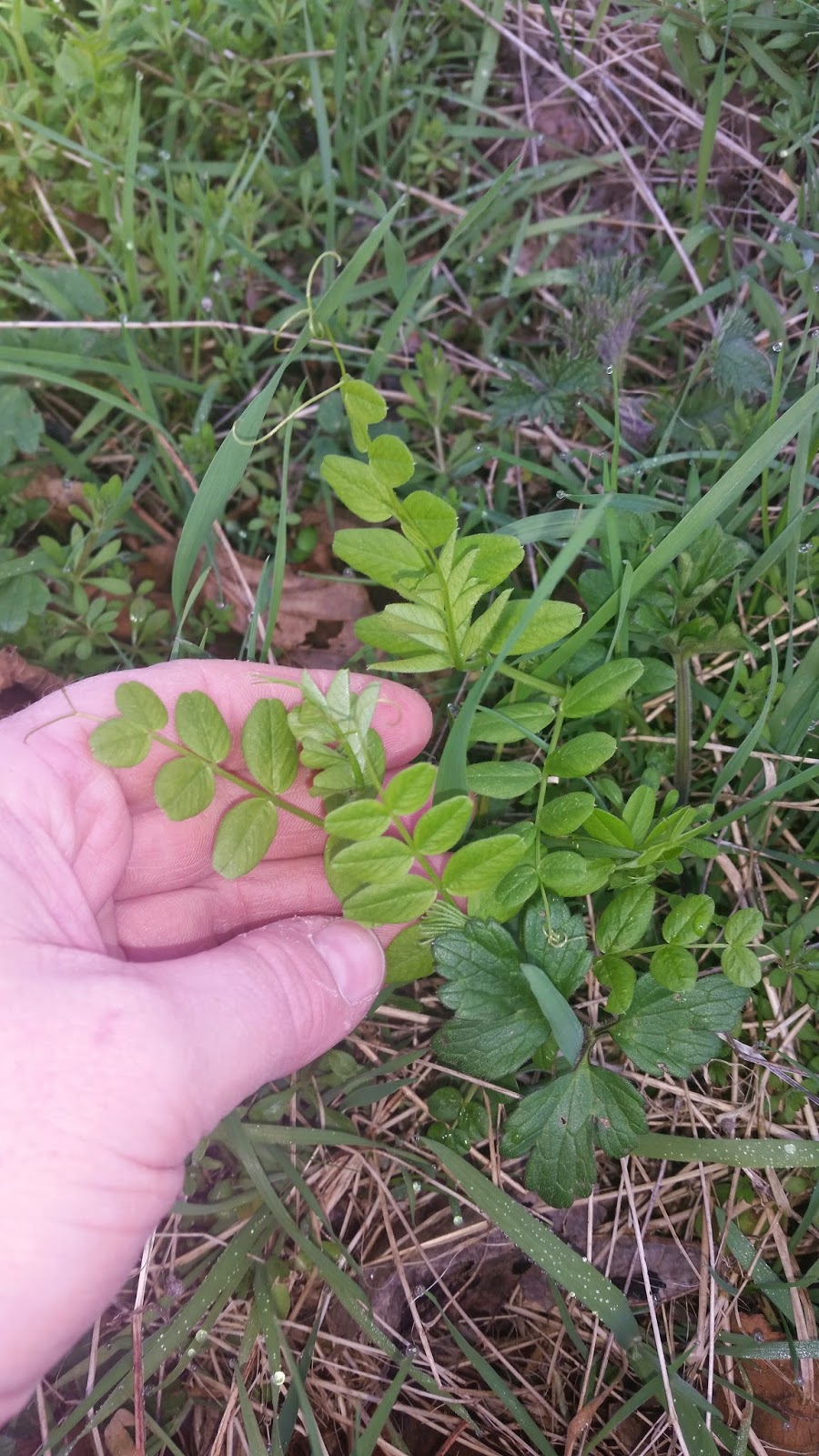
This is a member of the pea family, and pods will appear later in the year. I refer you again to the celtnet site or Google "Vetch Recipes". Vetch is also a useful plant for using as mulch, and is particularly good for mulching your strawberry patch. My experience of this plant ends there.

Finally, an edible (for my tastes) plant: Currant:


When identifying a currant bush, it helps to acquaint yourself with the leaf of the flowering currant, which is seemingly ever-in-blossom. Fruiting currants flower later than the flowering variety, which also helps with identification. I am always happy when I find a patch of wild redcurrants, because then I can make redcurrant jelly - the perfect ingredient for rich berry and wine sauces to compliment game.

And, back to the greens - Garlic Mustard:


A common sight in most hedgerows, Garlic Mustard has the scent and taste of garlic, and is used by many as a wild salad green. I am not one of the many.

And finally, Wild Viola/Violet:


This little flower can often be found peeking out of the undergrowth. Its flowers and leaves are used in many wild green recipes, but I am yet to use it. I might use it in a future recipe, with a nod to my childhood love of parma violets.

And that brings us to the end of our whistle-stop tour of spring greens. Roll on the summer, so I can indulge in the eating of my foraged finds!

Wednesday, 15 April 2015

Sloe Start to the Year

So here I am again, resurrecting my blog. I have realised that being unable (or unmotivated) to cook has been a barrier to me writing this blog, so I've decided to post everything that I forage, regardless of whether I cook with it. Here goes...

Spring is a wonderful time, we get to see life reappearing after winter, and my foraging heart absolutely loves surveying my surroundings for potential foraging spots.

It may seem odd to be out looking for Sloes (Blackthorn) in spring, as the fruit will not appear until Autumn, but April is the best time for locating Blackthorn bushes - even from a distance. At this time of year, Blackthorn blossom is showing, and it is unmistakable (well, I guess more so for the trained eye). Look out of the window if you are travelling and you will likely spot the white blossom in stark contrast to the seemingly black branches of the Blackthorn. Spotting a large patch at this time of year and returning to that spot in the Autumn is surely the easiest way to secure your supplies for Sloe Gin over the winter.


Blackthorn blossom (as with most prunus/plum species) has an almondy aroma and I have decided to trial some recipes to try to make the most of their flavour.


Trial 1: Almond Tisane Flavour

Dried Blackthorn blossom for use in Herbal Tisane (herbal tea requires the presence of tea, so flavoured waters are referred to as tisanes)

I use a dehydrator for drying fruits, nuts and flowers, but you can also use your oven at its lowest setting. This recipe has no strict quantities, I am just drying a couple of handfuls of blossoms for later use.

Trial 2: Blackthorn Blossom Liqueur


I always have a selection of homemade liqueurs around the house. They make wonderful presents, and are also a great added ingredient for puddings. I have tried making Blackthorn Blossom liqueurs in the past, but have never been inspired by the outcomes. I decided to try something a little different this time.

The inspiration for this recipe came from considering complimentary flavours for Almond. I decided to try to make a post-curry Digestif, using coconut rum as a base. When making liqueurs, it is recommended that you a base spirit with an ABV of 40% or higher and, although I have had success with fruit liqueurs from vodka with an ABV of 37.5%, I cannot guarantee that using a low ABV spirit (coconut rum is only 20%) will yield successful results. This is what my mum would call a "makey-uppy" and what I am calling "experimental".

Ingredients:

1 small food bag full of Blackthorn Blossom
70cl bottle of Malibu (coconut rum)

Method:

1. Remove leaves, stalk and branches from blossom
2. Place blossom in a 1-litre kilner jar
3. Pour rum over blossom
4. Stir
5. Screw lid onto jar

I will leave this to infuse for a few weeks, shaking the jar every day. I will post the results in due course.

This/next month will see the appearance of the St George's Mushroom and I hope to be able to find a few and post about them here, soon. Until then, happy Sloe-spotting! x

Friday, 19 October 2012

Wild Pear Part 5: Wild Pear and Bramble Leather

I got a message inviting me to relieve the bramble bushes of their fruit on a friend's land, so I dutifully obliged. As I still had a few pears left I decided to make some fruit leather. This isn't really a well-known treat in Scotland but my uncle used to send us dried fruit leathers from South Africa so they always remind me of my childhood. I guess they are similar to Fruit Roll ups or Humzingers, but without the preservatives.

I cooked the brambles and pears separately because I don't have a blender with filter to remove skin, seeds and other bits and pieces which would be detrimental to making a smooth leather. If you do have a blender with this facility then you don't even need to peel the pears - just chop them up and cook everything together then blend it all through the filter and continue with the recipe at the drying stage.

Wild Pear Part 5: Wild Pear and Bramble Leather

Ingredients:
  • 1kg brambles, rinsed
  • 1 litre of water
  • 1kg pears, peeled and chopped
  • Sugar
  • 1 tsp cinnamon
  • 1 star anise
Method:
  • Cook brambles and star anise in 500ml of water until very soft
  • Cook pears and cinnamon in 500ml of water until very soft
  • Blend pears in food processor/blender
  • Sieve brambles to remove star anise and seeds
  • Add sugar to taste but remember that the leather will sweeten as it dries so don't over-sweeten it!
  • Boil mixture until it becomes a thick sauce
  • Line dehydrator trays with baking paper and pour mixture on top - if you don't have a dehydrator then line a baking tray, pour the mixture into this and bake at your oven's lowest setting for 8+ hours - checking frequently
  • Dry until no longer sticky but still pliable (about 8 hours at 80C)
  • Roll leather up and cut into bite-sized pieces
Wild Pear and Bramble Leather
And that's me finally add the end of my 5kg of pears and this ingredient's blog. Until next time xx